
When Your Gut Problems Keep Coming Back
Your bloodwork looks fine. Your colonoscopy came back clean. And yet the bloating, reflux, cramping, or unpredictable bathroom trips haven’t gone anywhere. If you’ve been told “everything is normal” while your gut clearly disagrees, you’re not imagining it, and you’re not alone.
That gap between test results that look healthy and a body that doesn’t feel healthy is where a bigger question starts. Should you keep working with a gastroenterologist, or does a functional medicine approach fit better? It’s the same body either way. What changes is the lens each one uses.
What a Gastroenterologist Does (and Does Well)
A gastroenterologist is a medical doctor (MD or DO) with years of specialized training in the digestive tract, from the esophagus down through the stomach, intestines, liver, and colon. Their job is to diagnose and treat structural and disease-based problems, and they’re very good at it.
Training and scope
This is the specialist who performs and reads procedures like endoscopy and colonoscopy. They diagnose and rule out serious conditions such as inflammatory bowel disease (Crohn’s and ulcerative colitis), ulcers, celiac disease, and gastrointestinal cancers. When your symptoms could point to something that needs a biopsy, a scope, or a prescription, this is the training you want in the room. According to Johns Hopkins Medicine’s guide to digestive health providers, gastroenterologists are the physicians equipped to investigate and manage the full range of digestive diseases.
When a gastroenterologist is the right call
Some symptoms should never be handled with diet and lifestyle changes alone. See a gastroenterologist promptly if you have any of these warning signs:
- Blood in your stool, or black, tarry stools
- Unexplained weight loss
- Trouble or pain when swallowing
- Persistent vomiting
- Iron-deficiency anemia
- A family history of colon cancer, IBD, or celiac disease
- New digestive symptoms after age 50
These are the moments where conventional gastroenterology saves lives. Their tools catch things a root-cause conversation simply can’t, and any honest comparison has to start there.
What Functional Medicine Asks Instead: “Why Is This Happening?”

Here’s the core difference. Conventional care tends to ask, what disease do you have? Functional medicine asks, why is your system off in the first place?
At Monarch, we think of it as being a body detective. Instead of stopping at the symptom, we look at what’s driving it: what you eat, the balance of bacteria in your gut, how you sleep, your stress load, your hormones, and hidden inflammation. Two people can have the exact same bloating for completely different reasons. A personalized plan only works when it’s built on your specific “why,” not a generic label.
Two people can have the exact same bloating for completely different reasons.
The gut is connected to everything
Your gut doesn’t work in a bubble. It’s in constant, two-way conversation with your brain, your immune system, your energy, and even your mood. That’s why gut trouble so often shows up alongside anxiety, brain fog, poor sleep, or fatigue. As Johns Hopkins Medicine explains on the brain-gut connection, the digestive system and the brain are so tightly linked that distress in one routinely triggers symptoms in the other. Treating the gut as an isolated organ misses half the picture.
Evidence it works
This isn’t wishful thinking. A review of integrative medicine for gastrointestinal disease in the NIH’s PubMed Central found growing evidence that dietary change, stress reduction, and mind-body techniques can improve digestive symptoms, and in some cases shift the underlying physiology and course of disease. Addressing the terrain the gut lives in, not just the symptom, has real support behind it.
Side-by-Side: Functional Medicine vs. Gastroenterologist
| Gastroenterologist | Functional Medicine | |
|---|---|---|
| Main question | What disease is present? | Why is the system out of balance? |
| Typical tools | Endoscopy, colonoscopy, imaging, biopsies, prescriptions | In-depth history, advanced labs, diet, lifestyle, targeted support |
| Best for | Structural disease, red-flag symptoms, cancer screening | “Normal tests” but ongoing symptoms, chronic patterns |
| Time per visit | Often brief and focused | Longer, whole-person appointments |
| View of symptoms | Signs of a specific disease to diagnose | Signals pointing to an underlying imbalance |
| Treatment style | Procedures and medications | Nutrition, sleep, stress, gut and hormone support |
The honest takeaway? This isn’t a contest with one winner. It’s about which lens fits your situation, and for a lot of people the answer is both, in the right order.
When to Choose Which
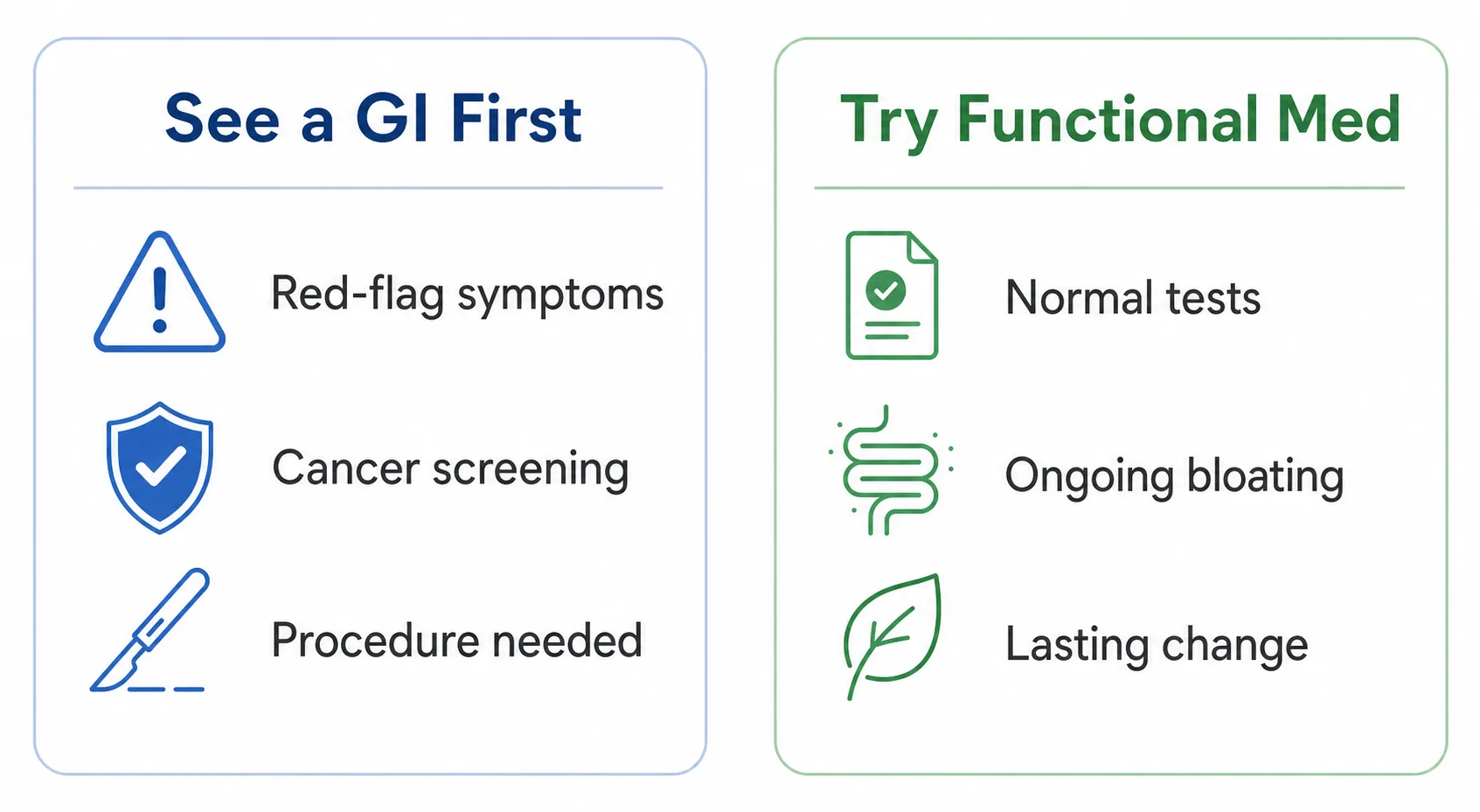
See a gastroenterologist first if:
- You have any red-flag symptom from the list above
- You’re due for colon cancer screening
- Your symptoms are severe, sudden, or getting worse fast
- You may need a procedure, biopsy, or prescription-level treatment
Ruling out serious disease always comes first. Safety isn’t negotiable.
Functional medicine may help most when:
- Your tests keep coming back “normal,” but you still don’t feel normal
- You deal with ongoing bloating, gas, reflux, or unpredictable bowel habits with no clear cause
- You’ve been handed an IBS diagnosis and a prescription, but no real explanation
- You want changes that last, driven by diet and lifestyle rather than a lifetime of managing symptoms
The best of both
The smartest path is usually not either/or. Let a gastroenterologist rule out the serious stuff, then work with a functional medicine provider to dig into the root causes of what’s left. One protects you from what’s dangerous; the other helps you understand and unwind what’s chronic.
The Most Common Functional Gut Disorder
Wondering what the most common functional gastrointestinal disorder is? The answer is irritable bowel syndrome (IBS). It accounts for a large share of people living with ongoing digestive complaints.
So what does “functional” mean here? It means the gut isn’t structurally damaged, no ulcer, no tumor, no visible disease on a scope, but it still isn’t working the way it should. The plumbing looks fine; the function is off. That’s exactly where a root-cause approach shines, because there’s no lesion to cut out or medicate away. The imbalance lives in the diet, the gut bacteria, the stress response, and how the gut and brain talk to each other, all things a functional plan is built to address.
Finding an Integrative or Functional Medicine GI Provider Near You
If you’ve been searching for an “integrative gastroenterologist near me” or a “functional medicine gastroenterologist near me,” you’ve probably noticed the results are thin. There’s a reason.
She’s trying to find a functional medicine doc to help. But I know nothing of the world of functional medicine and would love some recommendations.
How many integrative GI doctors are in the US?
We won’t hand you a made-up number, because no reliable figure captures it cleanly. What’s true: integrative and functional-trained GI providers are still a small, though growing, group. Traditional gastroenterology training doesn’t emphasize nutrition, gut bacteria, or lifestyle, so relatively few conventional GI doctors practice this way. That’s why many people don’t find their answer inside a hospital GI department at all. Instead, they work with a functional medicine practice that specializes in gut health and takes the time conventional visits often can’t.
What to look for in a provider
When you’re evaluating an integrative GI doctor, look for:
- A genuine root-cause focus, not just symptom management
- Real time spent understanding your full history
- A personalized plan built for you, not a one-size protocol
- A licensed clinician you can trust
A quick, honest note on geography: Monarch Functional Medicine serves clients in Michigan, where we’re a licensed provider. If you’re in Michigan and tired of chasing symptoms, that’s who we’re here for.
How Monarch Approaches Chronic Gut Issues
Our whole reason for existing is to turn confusion into clarity. When you’ve collected a stack of “normal” results and still feel awful, we connect the dots that get missed, between your labs, your daily habits, your hormones, your metabolism, and your gut health, and pull them into one personalized roadmap you can actually follow.
Every patient starts in the same place: our 12 Week Reset. It’s the foundation, where we uncover what’s really driving your symptoms and start rebuilding from the root. If you’re in Michigan and ready to stop guessing, this is your first step toward feeling like yourself again.