Written under the guidance of Julie McDonald, PA-C, co-owner of Monarch Functional Medicine
Why the Day You Test Can Affect Some Hormone Results
Hormone levels change across the menstrual cycle, and the timing that matters depends on which test is ordered and what question it is meant to answer. A result collected at the wrong time for that question may be harder to interpret.
Cycle timing is only one part of the picture. A result should be considered alongside your cycle history, symptoms, medications, and the reason for testing. This guide explains common timing patterns; it is not a recommendation that everyone needs a hormone panel.
For this guide, Day 1 means the first day of menstrual bleeding your clinic or lab counts as full flow. Spotting may not count, but follow the instructions from the provider ordering your test.
The quick answer:
The rest of this guide explains these timing patterns and what to ask if your cycle is irregular.
Your Cycle in Plain Words: The Two Phases That Matter for Testing
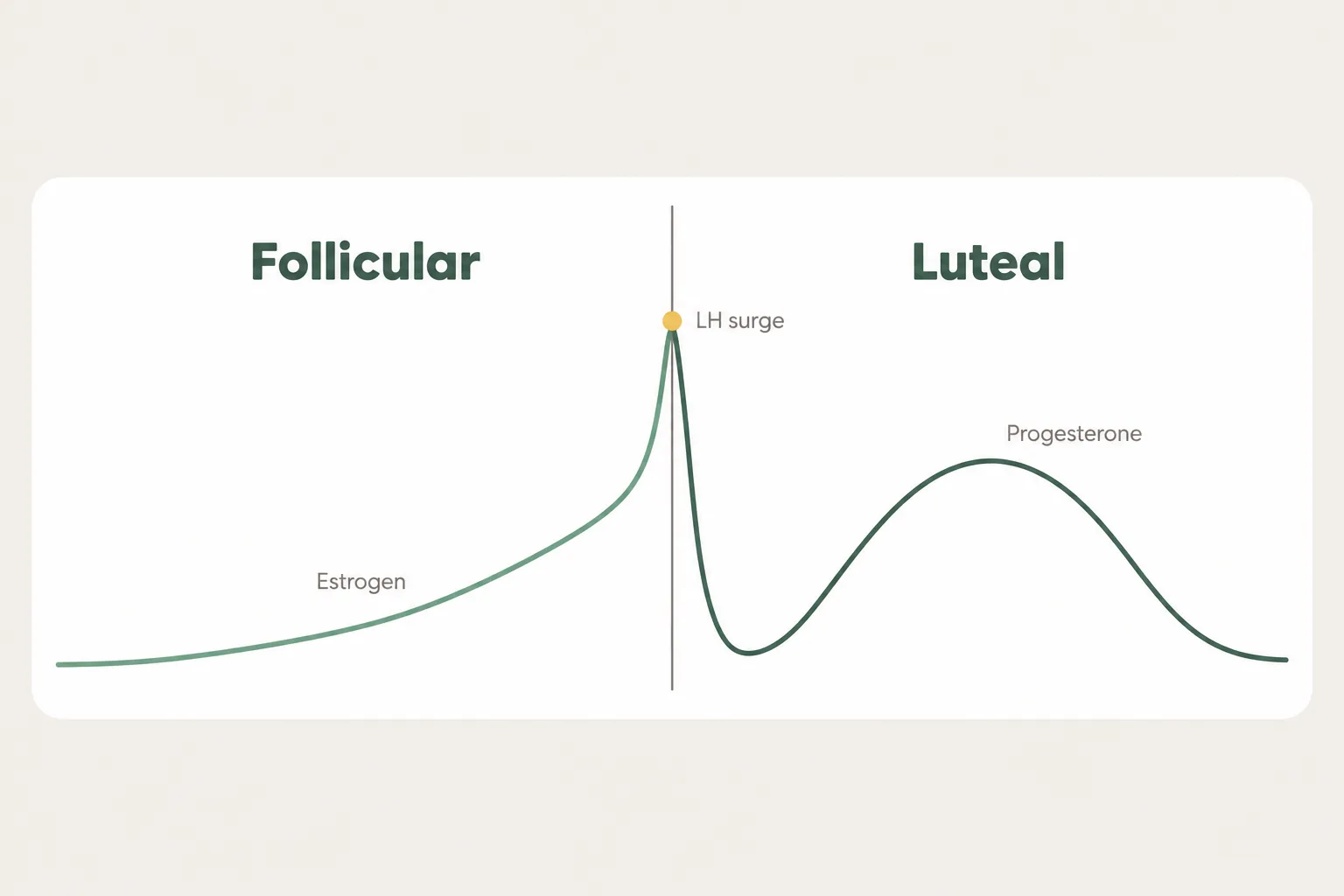
Think of your cycle as two halves with a turning point in the middle.
The first half (the follicular phase). This starts on Day 1. Your brain sends out two messenger hormones, FSH (follicle-stimulating hormone) and LH (luteinizing hormone), telling your ovaries to get an egg ready. As that egg matures, estrogen slowly builds.
The turning point (ovulation). A sudden spike in LH tells the ovary to release the egg. In a 28-day cycle, this usually happens around day 14, but it varies a lot from woman to woman.
The second half (the luteal phase). After ovulation, the spot the egg left behind starts making progesterone. Progesterone has a calming, steadying effect, supports sleep and mood, and prepares the uterus for a possible pregnancy. If no pregnancy happens, progesterone and estrogen both drop and your period starts.
Is estrogen high or low during your period? It’s typically at its lowest early in your period. That’s why days 2-5 are used for baseline testing: hormones are quiet, so the lab gets a clean starting picture of how your brain and ovaries are talking to each other.
Quick Reference: When Cycle Timing May Matter
Related readingFunctional Medicine and Low Progesterone in Women: CausesRead the guide →| Test | Common timing when ordered for a specific evaluation | Important context |
|---|---|---|
| FSH and estradiol | Early follicular phase, often cycle days 2–4 in fertility or ovarian-reserve evaluations | Interpret together and in relation to the clinical question. |
| LH | May be measured early in the cycle for some evaluations; timing depends on why it was ordered | A single result does not confirm ovulation timing. |
| Progesterone | About 6–8 days after ovulation, or roughly a week before the expected period | Helps assess whether ovulation recently occurred; one value cannot determine luteal-phase quality or fertility. |
| Testosterone and SHBG | Timing depends on the reason for testing and the laboratory method; some evaluations use an early-cycle sample | Ask whether to test in the morning or at a certain cycle phase. |
| DHEA-S | Often less dependent on cycle day, but follow the clinician’s instructions | The reason for testing affects interpretation. |
| Prolactin | Often collected after resting; timing and preparation may vary | Stress, exercise, sleep, and some medicines may affect results. |
| AMH | Often can be measured on different cycle days | It does not measure egg quality or guarantee fertility; hormonal contraception may affect results. |
| Thyroid tests | Usually do not require a particular cycle day | Follow instructions about medication timing and repeat testing. |
| Cortisol | Depends on the condition being evaluated and the test type | A single morning blood draw is not interchangeable with multi-timepoint saliva or urine testing. |
You can test testosterone, DHEA, prolactin, cortisol, thyroid on day 3 too. Day 19-21 (after ovulation) you can check progesterone.Read on Reddit ↗
Early-Cycle FSH and Estradiol: Days 2–4 in Some Evaluations
When clinicians order FSH and estradiol for an ovarian-reserve evaluation, they commonly measure them in the early follicular phase. The American Society for Reproductive Medicine recommends testing basal FSH and estradiol on days 2–4 in this context.
Day 3 is often used, but follow the exact day requested by your clinician or lab. Estradiol can help interpret FSH in this context; neither result alone diagnoses perimenopause or explains symptoms.
Day 1 is the first day your clinic or lab counts as full menstrual flow. If bleeding begins late at night or you are unsure whether spotting counts, ask the lab or ordering clinician how to count it.
What Day of Cycle to Test Progesterone
A fixed “day 21” test is only a useful estimate for some 28-day cycles. The aim is usually to test in the mid-luteal phase, about 6–8 days after ovulation or approximately one week before the expected next period.
Examples based on a predictable cycle and an expected period:
- 25-day cycle: ovulation around day 11, test around day 18
- 28-day cycle: ovulation around day 14, test around day 21
- 32-day cycle: ovulation around day 18, test around day 25
- 35-day cycle: ovulation around day 21, test around day 28
These are estimates, not a personalized schedule. ASRM notes that progesterone levels fluctuate and a single result can support evidence of recent ovulation, but no one value defines a normal or fertile luteal phase. Read ASRM’s guidance on luteal-phase evaluation.
Symptoms such as sleep changes, anxiety, irritability, short cycles, or spotting can have many causes. They do not confirm low progesterone. For more about Monarch’s service, see its page on low progesterone evaluation.
Best Day of Cycle to Test Testosterone
There is no single timing rule for every testosterone test in women. Cycle phase, time of day, the reason for testing, and the laboratory method may matter. Ask the ordering clinician whether your sample should be collected in the morning or during a particular phase.
If SHBG is ordered with testosterone, it can help interpret how much testosterone is bound in the blood. The result still needs to be considered with symptoms and the reason for testing.
Tests With Less Cycle-Day Dependence: Follow the Test-Specific Instructions
Some tests, including thyroid tests and often AMH or DHEA-S, may not require a specific cycle day. That does not mean every test can be taken at any time or interpreted without context. For example, AMH may be affected by hormonal contraception and does not measure egg quality.
Prolactin may be affected by stress, sleep, exercise, and other factors. Your clinician or lab may ask you to rest before the blood draw or follow other instructions.
Cortisol testing is specific to the question being evaluated. A morning blood test, a late-night saliva test, and a multi-sample saliva or urine test measure different things and are not interchangeable. Monarch explains cortisol-test choices and their limits here.
Does Time of Day Affect Estrogen Test Results?
For many cycle-related evaluations, cycle phase matters more than choosing a specific time of day for an estradiol test. No universal time of day makes estrogen highest for everyone. Follow the lab’s instructions, especially if other tests in the panel have time-specific requirements.
If several tests are being collected together, ask whether they should be drawn at the same time of day when you repeat them.
How to Time Testing If Your Cycles Are Irregular
If cycles vary, calendar estimates may not predict ovulation well. Ask the ordering clinician how to time progesterone testing for your situation.
- Ovulation predictor kits (OPKs): These detect an LH surge that usually occurs before ovulation. A positive test does not pinpoint the exact time of ovulation, so ask how many days later to schedule progesterone testing.
- Basal body temperature (BBT): A sustained temperature rise can help identify that ovulation likely happened, but it confirms a pattern after the fact and is not a diagnosis.
- Cycle-tracking apps: Apps estimate from past cycles; they do not confirm ovulation in the current cycle.
If periods are absent or unpredictable, a clinician may choose a different testing plan or first evaluate possible reasons for the cycle changes. Do not assume that a random-day panel answers the same question as a cycle-timed test.
Hormone Testing When PCOS Is Suspected
Cycle timing is only one part of a PCOS evaluation. Depending on the symptoms and history, a clinician may order androgen or other tests and consider non-hormone factors. No single blood test diagnoses PCOS.
Cycle Day 3 is ideal to check your hormone levels. They should have checked testosterone and other androgens, A1C, FSH, LH, estrogen, AMH …Read on Reddit ↗
Metabolic screening may also be appropriate, but fasting insulin is not a routine diagnostic test for everyone with PCOS. The international PCOS guideline notes that commonly available insulin assays have limited clinical relevance in routine care.
When Hormone Testing May Be Used During Perimenopause
Perimenopause is often assessed by age, symptoms, and changes in menstrual cycles. A single FSH result can vary and does not rule perimenopause in or out. ACOG says many people do not need hormone testing to identify perimenopause, although testing may be considered in some younger patients or when another clinical question needs an answer. Read ACOG’s guidance on hormone testing during perimenopause.
If a clinician orders cycle-timed tests, follow the specific instructions. Tracking symptoms and cycle dates may help provide context, but testing is not necessary for everyone with perimenopause symptoms. Learn more about Monarch’s perimenopause care in Michigan.
Testing on Birth Control, HRT, or After Periods Stop

On hormonal birth control: Methods differ in how they affect ovulation, bleeding, and hormone levels. Tell the clinician which method you use and ask how it affects the specific tests ordered. Do not stop birth control just to test unless your prescriber tells you to.
On hormone therapy (HRT): The product, dose, route, and timing of your dose may affect test interpretation. Ask the prescriber when to have the blood draw in relation to your medication.
If you no longer have periods: Some tests can be collected on any day, but the appropriate tests depend on why they were ordered and whether you are postmenopausal, have had a hysterectomy, or have another reason for not bleeding.
While breastfeeding: Nursing can affect prolactin and reproductive hormones. Tell your clinician and ask how that affects the test plan.
Signs Your Hormones May Be Out of Balance
People often search for “the 5 signs” or “11 signs your hormones are out of whack.” There’s no official list, but these are the patterns we hear about most:
- Irregular, very heavy or very light periods
- PMS that’s getting worse with age
- Trouble falling or staying asleep
- Fatigue that rest doesn’t fix
- Brain fog or trouble focusing
- Weight gain, especially around the middle
- Low libido
- Mood swings, irritability, or anxiety
- Hot flashes or night sweats
- Changes in hair or skin (thinning hair, acne, dryness)
- Headaches or migraines around your period
Almost every one of these can also come from thyroid problems, blood sugar swings, chronic stress, poor sleep, or gut issues. A list of symptoms points in a direction; well-timed labs and a full history help show where the problem actually starts.
If your symptoms cluster in the week or two before your period, our page on PMS and PMDD cycle-phase lab evaluation goes deeper into how we read that luteal-phase picture.
Your Pre-Test Checklist
A few minutes of prep makes your results more useful:
- Write down Day 1 of your last two or three periods and work out your average cycle length.
- Confirm ovulation with an OPK or BBT if you’re testing progesterone.
- Book a morning draw, ideally at a time you can repeat later.
- Ask about biotin. High-dose biotin, common in hair, skin, and nail supplements, can interfere with some lab tests. Ask your provider whether, and for how long, to pause it before your draw.
- List everything you take: medications, birth control, HRT, and supplements.
- Note how you feel on test day: sleep the night before, stress, illness, or anything unusual.
- Ask whether to fast. Most hormone tests don’t require it, but blood sugar and insulin markers often do.
Why Timing Is Only One Part of Test Interpretation

Timing can help answer a specific clinical question, but a lab result does not explain symptoms on its own. A clinician may consider cycle dates, symptoms, medical history, medications, and relevant results together before recommending next steps.
Julie McDonald, PA-C, has more than two decades of experience in family, emergency, and functional medicine. At Monarch Functional Medicine, hormone concerns are considered alongside relevant health history and other factors. Care is available in person in Marquette and virtually across Michigan.
Frequently asked questions
What day of cycle is best for hormone testing?
What day should I test progesterone if my cycle is not 28 days?
Can I test hormones while on my period?
Do I need hormone testing to know if I’m in perimenopause?
Do I need to fast for hormone blood tests?
Can I test hormones while taking birth control or HRT?
Ready for Answers That Make Sense?
If you have questions about hormone symptoms or lab results, a clinician can help decide whether testing is appropriate and how to interpret it. Monarch’s 12 Week Reset is the starting point for its patients and is available to people in Michigan. Learn more about the 12 Week Reset.