Small intestinal bacterial overgrowth can cause bloating, abdominal pain, constipation, diarrhea, food reactions, fatigue, and brain fog. In this article, we explore how a functional medicine approach to SIBO treatment looks beyond short-term symptom relief and focuses on testing, root causes, gut repair, motility, nutrition, and long-term prevention.
Functional Medicine Approach to SIBO Treatment
A functional medicine approach to SIBO treatment starts with a better question. Not just, “What can calm the bloating?” But, “Why are bacteria building up in the small intestine, and what needs to change so this does not keep coming back?”
That shift matters. SIBO, short for small intestinal bacterial overgrowth, can feel unpredictable. A person may eat one meal and feel fine, then eat the same food a few days later and end up bloated, foggy, uncomfortable, or stuck in the bathroom. Some people deal with constipation. Others deal with loose stools. Some swing between both. Many also notice reflux, food sensitivities, fatigue, poor sleep, and a strange heaviness after meals.
The usual search starts with relief. People look up SIBO treatment, SIBO remedies, how to cure SIBO, how to fix SIBO, digestive enzymes for SIBO, berberine for SIBO, oregano oil SIBO protocol, methane SIBO herbal treatment, or a SIBO protocol PDF. That search makes sense. When the gut feels off every day, people want answers.
But here’s the problem. SIBO is not always a simple “too much bacteria” issue. It is often a sign that something about the digestive environment has changed. Motility may be slow. Stomach acid may be low. Constipation may be present. Thyroid function, stress, sleep, blood sugar, inflammation, medications, food poisoning history, or structural abnormalities may be part of the picture.
That is why root-cause SIBO care looks at more than symptom control. It asks what allowed bacteria in the small intestine to overgrow in the first place.
For Michigan patients, that idea fits the care philosophy at Monarch Functional Medicine. The practice helps people move from confusion and frustration to clarity, confidence, and lasting health by looking deeper at symptoms tied to gut health, hormones, thyroid function, metabolism, inflammation, stress, sleep, and nutrition. SIBO can sit right in the middle of that web.
A good SIBO treatment plan should not feel like a guessing game. It should help the patient understand what is happening, what needs attention first, and what kind of support may reduce the chance of relapse.
Small Intestinal Bacterial Overgrowth and IBS Symptoms
SIBO happens when there is an abnormal increase in bacteria in the small intestine. The small intestine is not supposed to be sterile, but it should not act like the large intestine either. When too many microbes ferment food too early in digestion, gas can build up. That bacterial fermentation may lead to bloating, pressure, abdominal pain, belching, reflux, nausea, diarrhea, constipation, or a heavy feeling after meals.
Many people first hear about intestinal bacterial overgrowth SIBO after years of irritable bowel syndrome IBS symptoms. The overlap is real. IBS symptoms can include bloating, bowel changes, abdominal pain, gas, and food reactions. SIBO can cause many of the same issues.
The American College of Gastroenterology defines SIBO as “the presence of excessive numbers of bacteria in the small bowel, causing gastrointestinal symptoms” in its clinical guideline on small intestinal bacterial overgrowth. That definition is useful because it keeps the focus on both symptoms and clinical context.
A person should not diagnose SIBO from bloating alone. Similar symptoms can come from celiac disease, inflammatory bowel disease, gallbladder dysfunction, pancreatic enzyme insufficiency, thyroid dysfunction, food sensitivities, histamine intolerance, medication effects, or other digestive conditions. Still, when bloating, bowel changes, fatigue, and food reactions keep returning, SIBO deserves a closer look.
This is where Monarch’s “body detective” approach fits especially well. The point is not to label a person quickly. The point is to understand why the body is sending the same signals again and again.
How Functional Medicine Practitioners Diagnose SIBO
A personalized SIBO treatment strategy usually starts with the patient’s story. When did symptoms begin? Did they start after food poisoning, antibiotics, a stressful season, surgery, a major hormone shift, or a period of poor sleep? Is constipation part of the picture? Because sluggish motility also slows hormone clearance, it helps to understand how gut issues drive hormone symptoms alongside the usual SIBO workup. Is diarrhea more common? Are symptoms worse after certain carbohydrates, sulfur foods, high-fat meals, or supplements?
Breath testing is one of the most common ways to test for SIBO. Glucose or lactulose breath tests measure gases released after a person drinks a test solution. Breath testing is only one piece of the picture, and our overview of testing that identifies digestive root causes explains how it fits alongside stool analysis, inflammation markers, and other diagnostics. Hydrogen and methane are the two main gases measured in most tests. Some newer testing options also look at hydrogen sulfide patterns, though access and interpretation can vary.
The ACG guideline suggests breath testing in certain symptomatic patients and methane testing when constipation is present. That matters because methane patterns are often linked with slower bowel transit, while hydrogen patterns are more often tied to loose stools or diarrhea.
Breath testing is helpful, but it is not perfect. Test prep matters. Recent antibiotics, probiotics, laxatives, colonoscopy prep, certain foods, and timing can affect results. Small bowel aspirate and culture is sometimes discussed as a gold standard, but it is invasive and not commonly used in everyday outpatient care. In real clinical practice, breath testing, symptoms, medical history, and risk factors are usually read together.
A functional medicine provider may also look at nutrient status, thyroid markers, blood sugar balance, inflammation, stool patterns, digestive enzyme function, stomach acid clues, food sensitivities, medication history, and signs of structural abnormalities. That wider lens can be especially useful for people who have been told “everything looks normal” but still feel unwell.
| Evaluation Area | Why It Matters | What May Be Reviewed |
| Breath testing | Helps identify hydrogen, methane, or mixed patterns | Glucose or lactulose test, symptom timing, constipation or diarrhea pattern |
| Motility | Slow movement can allow bacteria to collect in the small intestine | Meal spacing, thyroid function, constipation, stress, medications |
| Digestive function | Poor breakdown of food may worsen fermentation | Stomach acid clues, bile flow, digestive enzymes, reflux history |
| Nutrient status | SIBO may affect absorption in some people | B12, iron, vitamin D, magnesium, protein intake, fatigue patterns |
| Root causes | Recurrence often points to an unresolved driver | Food poisoning, surgery, adhesions, hormones, sleep, stress, blood sugar |
If gut symptoms overlap with fatigue, brain fog, hormone changes, or weight resistance, Michigan patients can start with Monarch’s 12-Week Energy, Hormone & Metabolism Reset. It gives patients a structured starting point instead of another round of trial and error.
Why SIBO Treatment Should Match the Gas Pattern
SIBO treatment should fit the pattern. Hydrogen-dominant SIBO is often associated with loose stools, diarrhea, urgency, and bloating. Methane-dominant overgrowth, often referred to as intestinal methanogen overgrowth, is more often connected with constipation and slow transit. Hydrogen sulfide patterns may involve diarrhea, sulfur sensitivity, rotten-egg-smelling gas, or unusual reactions to certain foods.
This is one reason random SIBO remedies can backfire. Someone with constipation may try the same oregano oil SIBO protocol that helped another person with diarrhea. Someone may use berberine for methane SIBO when their bigger issue is slow motility. Another person may search for berberine dosage for SIBO or oregano oil dosage for SIBO without knowing whether those choices are safe with their medications, health history, or symptoms.
Natural does not always mean harmless. Berberine, oregano oil, neem extract, allicin, uva ursi, FC-Cidal, Dysbiocide, Candibactin AR, Candibactin BR, and other herbal antimicrobials may have a place in some SIBO herbal protocol plans. They may also irritate the gut, interact with medications, or be a poor fit during pregnancy, breastfeeding, liver disease, kidney disease, autoimmune flares, or severe supplement sensitivity.
The better question is not, “What kills SIBO the fastest?” It is, “What is the safest plan for this person’s SIBO pattern, digestive function, and long-term gut health?” That question leads to better care.
SIBO Treatment Protocol: Remove, Replace, Repair, Rebalance
A strong SIBO treatment protocol needs order. Without order, patients often end up taking too many supplements, cutting too many foods, and still not knowing what helped. Root-cause SIBO care often follows a phased model. The details vary by patient, but the structure helps reduce confusion.
| Phase | Main Purpose | What It May Include |
| Confirm | Make sure the plan starts with evidence, not guessing | Breath testing, symptom review, red-flag screening, medical history |
| Remove | Reduce overgrowth and calm major triggers | Prescription antibiotics, herbal antimicrobials, short-term diet support |
| Replace | Improve digestion and food breakdown | Digestive enzymes, stomach acid support when appropriate, bile and nutrient support |
| Repair | Support the gut lining and rebuild tolerance | Protein, minerals, gut-lining nutrients, sleep, stress support, food reintroduction |
| Rebalance | Lower relapse risk | Motility support, meal spacing, constipation care, thyroid and hormone review |
Mayo Clinic notes that antibiotics are often the initial way to treat bacterial overgrowth, especially when symptoms and history strongly suggest SIBO. A functional medicine approach does not have to reject that. Good care is not “natural versus conventional.” Good care asks what is appropriate, safe, and useful for the individual.
Some patients may use rifaximin or another prescription option. Some may use herbal antimicrobials. Some may need constipation and motility care before aggressive antimicrobials make sense. Some need nutrition support because their food intake has become too restricted.
The treatment phase is only part of the story. If motility remains slow, constipation persists, stomach acid is low, thyroid function is under-addressed, or stress is constantly high, SIBO symptoms may return. Cleveland Clinic notes that symptoms commonly come back months after antibiotics when an underlying cause remains.
That is why a functional medicine SIBO plan should not stop at the “kill phase.” It should also ask how the gut will keep itself clean, move food forward, absorb nutrients, and tolerate a broader diet again.
Herbal Antimicrobials, Berberine, Oregano Oil, and FC-Cidal
Herbal antimicrobials get a lot of attention in functional medicine SIBO care. Many patients want options beyond antibiotics. Others have used antibiotics, felt better, and then relapsed. Some prefer a SIBO natural treatment protocol because they want a plan that includes digestion, gut lining support, food strategy, and motility.
A study published in Global Advances in Health and Medicine found that herbal therapy was at least as effective as rifaximin for breath-test resolution in the study group. That is a meaningful finding, but it should be handled carefully. The study was not a guarantee that every herbal protocol works for every patient. It also does not mean supplements should be used without clinical guidance.
Commonly searched options include berberine for SIBO, berberine and SIBO, berberine complex SIBO products, oregano oil, neem extract, allicin, FC-Cidal and Dysbiocide for SIBO, Candibactin AR and BR for SIBO, and uva ursi. People also search for how to take Candibactin AR and BR, how to take FC-Cidal and Dysbiocide for SIBO, berberine for SIBO dosage, and how much oregano oil for SIBO.
Those searches show a real need for clarity. They also show how easy it is for patients to self-treat without enough context.
| Common Search | Why Patients Search It | Safer Clinical Framing |
| Berberine for SIBO | They want plant-based antimicrobial support | May fit some plans, but dose depends on pattern, tolerance, and medication history |
| Oregano oil SIBO protocol | They want stronger natural support | Can irritate the gut if used too aggressively or too long |
| FC-Cidal and Dysbiocide protocol | They saw it in studies, forums, or practitioner plans | May be considered with guidance, not used as a universal protocol |
| Candibactin AR and BR for SIBO | They want a structured herbal option | Needs review for safety, tolerance, pregnancy status, and medication interactions |
| Methane SIBO herbal treatment | Constipation patterns often feel harder to clear | Usually needs motility and bowel support, not herbs alone |
Berberine may affect blood sugar and interact with medications. Oregano oil may be too harsh for sensitive patients. Allicin may be considered in some methane-focused plans, but not everyone handles sulfur-containing products well. Colloidal silver for SIBO is searched online, but it is not a preferred evidence-based option and carries safety concerns.
A better plan respects the power of herbs without treating them like candy. When used well, herbal antimicrobials can be one tool. They should not replace assessment, monitoring, or a prevention plan.
Digestive Enzymes, Stomach Acid, and Motility Support
Digestive enzymes for SIBO may help some people feel less full, less gassy, or less uncomfortable after meals. They can support the breakdown of protein, fat, or carbohydrates. Still, digestive enzymes are not a cure for SIBO.
The best digestive enzymes for SIBO depend on the person. Someone with greasy stools or trouble digesting fats may need different support than someone who feels heavy after protein. A patient with reflux, gallbladder issues, pancreatic enzyme concerns, or long-term acid-blocking medication use needs a more careful review.
Stomach acid also matters. It helps break down food and supports the body’s natural defense against excess microbes in the upper digestive tract. Low stomach acid can make food sit longer and may weaken digestive signaling. That does not mean every person should take acid support. It means the question belongs in the assessment.
Motility may be the most overlooked piece. Between meals, the small intestine has a cleaning rhythm called the migrating motor complex. It helps move food particles and microbes downward toward the large intestine. Constant snacking, poor sleep, chronic stress, hypothyroidism, certain medications, blood sugar swings, and nerve dysfunction may interfere with that rhythm.
So when people ask “how do I get rid of SIBO?” or “how do you fix SIBO?” the answer is not always another antimicrobial. Sometimes the missing piece is movement through the gut.
Practical motility support may include meal spacing, hydration, mineral support, constipation care, thyroid review, nervous system support, sleep consistency, gentle walks after meals, and clinician-guided prokinetics when appropriate.
Food Sensitivities, Low-FODMAP, and Diet Strategy
Diet can calm symptoms, but it should not become a life sentence. A low-FODMAP diet, low-fermentation diet, or short-term elimination plan may reduce bacterial fermentation and lower bloating while treatment begins. Some people feel relief quickly when high-fermentation foods are reduced. That relief can be useful.
But long-term over-restriction can create a new problem. The person may become afraid of food. Fiber intake may drop. Meals may become repetitive. Social eating becomes harder. The large intestine may receive less fuel from diverse plant foods. Over time, the diet that once helped may start to feel like a cage.
A personalized gut-health plan should use diet with purpose. First, calm the system. Next, treat the likely drivers. Then, reintroduce foods in a structured way so the patient can rebuild confidence.
This matters for patients with food sensitivities, histamine reactions, or MCAS-like patterns. Monarch has already covered related immune and gut themes in its guidance on histamine intolerance. For those experiencing bloating, fatigue, and brain fog, its coverage of leaky gut and hidden digestive triggers also links digestive dysfunction with broader systemic symptoms. Diet should help people participate in life again. It should not make them feel more trapped.
Can SIBO Cause Brain Fog or Neurological Symptoms?
SIBO and brain fog are often discussed together because patients notice patterns. They eat, their belly expands, and their mind feels slow. Some describe it as mental static. Others say they feel anxious, tired, detached, or unable to focus.
Can SIBO cause neurological problems? The answer needs care. SIBO may contribute to brain fog in some people, but it is rarely the only possible cause. Poor sleep, low thyroid function, hormone changes, nutrient deficiencies, blood sugar swings, inflammation, medications, stress, and anxiety can all affect mental clarity. If your digestive symptoms and mental cloudiness tend to show up together, it is worth understanding how bloating and brain fog can share one root cause before assuming they are two separate problems.
The gut and brain communicate through the nervous system, immune system, hormones, and microbial metabolites. When digestion is inflamed or unpredictable, the body may feel like it is working overtime. Add constipation, poor sleep, low nutrient intake, and chronic stress, and brain fog becomes easier to understand.
A root-cause SIBO plan may review B vitamins, iron, vitamin D, magnesium, thyroid function, glucose balance, inflammation, sleep quality, and stress load. This is where Monarch’s broader clinical lens matters. The patient is not just a gut. They are a whole person with connected systems.
For readers who have been told their lab work is fine but still feel off, Monarch’s take on normal labs and persistent symptoms speaks directly to that frustration.
What Helps SIBO Long Term?
Short-term symptom relief matters. No one wants to feel bloated after every meal. But long-term improvement depends on recurrence prevention.
SIBO often returns when the reason for overgrowth remains. Cleveland Clinic notes that symptoms can return several months after antibiotics, especially when an underlying condition continues to predispose a person to SIBO. That is exactly why functional medicine SIBO care looks beyond the first round of treatment.
For one person, the driver may be slow motility after food poisoning. For another, constipation and methane overgrowth may reinforce each other. Someone else may have low thyroid function, poor sleep, high stress, blood sugar imbalance, long-term acid suppression, or a history of abdominal surgery. Structural abnormalities, adhesions, diverticula, and blind loops may also increase risk.
This is why the phrase “SIBO cures” can be misleading. There is no single cure for SIBO that works for everyone. There are SIBO treatments, and there are root-cause strategies that make relapse less likely.
A long-term plan may include meal spacing, bowel regularity, motility support, thyroid review, food reintroduction, nutrient repletion, stress repair, sleep improvement, and maintenance care that fits real life. Some patients need repeat testing. Others need symptom tracking, nutrition support, and a clearer daily routine.
| Long-Term Driver | Why It Can Keep SIBO Active | Root-Cause Response |
| Slow motility | Bacteria are not swept downward well between meals | Meal spacing, prokinetic support, thyroid review, stress and sleep support |
| Methane pattern | Constipation can slow transit and worsen symptoms | Bowel regularity, methane-focused care, motility support |
| Low stomach acid | Food breakdown and upper-GI defense may weaken | Reflux history, medication review, clinician-guided digestive support |
| Food restriction | Symptoms may calm, but food tolerance can shrink | Planned reintroduction, nutrient density, gut-lining support |
| Stress and poor sleep | Nervous system strain can affect motility and digestion | Sleep rhythm, realistic stress tools, blood sugar support |
| Structural abnormalities | Physical changes may allow bacterial buildup | Medical evaluation, imaging, GI referral when needed |
For Michigan patients who want a structured place to begin, Monarch’s 12-Week Reset may help connect gut symptoms with metabolism, hormones, energy, inflammation, and lifestyle patterns instead of treating each concern as a separate problem.
When to Work With a SIBO Functional Medicine Doctor
It is easy to find SIBO treatments online. Treat SIBO at home. Try berberine and oregano oil for SIBO. Use digestive enzymes. Try aloe vera for SIBO. Look up neem for SIBO dosage. Compare Candibactin SIBO protocol reviews. Search FC-Cidal and Dysbiocide for methane SIBO. The internet has plenty of advice. Advice is not the same as care.
A SIBO functional medicine doctor or qualified functional medicine provider can help decide whether testing is needed, what gas pattern may be present, which treatments are safe, and what root causes deserve attention. That matters when symptoms are severe, constipation is stubborn, diarrhea is frequent, food tolerance is shrinking, weight loss occurs, nutrient deficiencies are present, or symptoms return after treatment.
Monarch Functional Medicine serves patients in Michigan and is based in Marquette. Julie McDonald, PA-C, FMACP, brings more than two decades of clinical experience across family medicine, emergency medicine, internal medicine, and functional medicine. Her approach combines medical training with a root-cause model that helps patients understand why symptoms may persist even when basic labs look normal.
For people who are not sure where to begin, a short strategy conversation can help clarify whether Monarch’s model is the right fit. You can book a 15-minute strategy session or reach the team.

FAQs About SIBO and Functional Medicine
What is the functional medicine approach to SIBO treatment?
The functional medicine approach to SIBO treatment looks at why bacteria are overgrowing in the small intestine. It may include breath testing, gas-pattern review, diet strategy, digestive enzymes, stomach acid support, herbal or prescription treatment, motility support, nutrient assessment, and recurrence prevention. The main difference is that care does not stop at reducing bacteria. If you are weighing your options for ongoing digestive symptoms, this breakdown of how functional medicine and gastroenterology compare for chronic gut issues explains what each path tends to look for and when one may serve you better than the other. It also looks at the terrain that allowed SIBO to develop.
Is SIBO the same thing as IBS?
No. IBS is a recognized diagnosis based on patterns of abdominal pain and bowel habit changes, while SIBO refers specifically to bacterial overgrowth in the small intestine confirmed by testing. The two overlap often; research suggests SIBO is present in roughly a third of IBS cases by some measures, and considerably more by others, but one doesn’t automatically confirm the other.
How accurate is SIBO breath testing?
Breath testing is useful but imperfect. Studies comparing it against small bowel culture have found lactulose breath testing detects only around 42% of confirmed cases and glucose breath testing around 55%. A negative result doesn’t rule SIBO out; it means the test didn’t catch it on that particular day, which is why symptom history still matters alongside any single test.
Does SIBO come back after treatment?
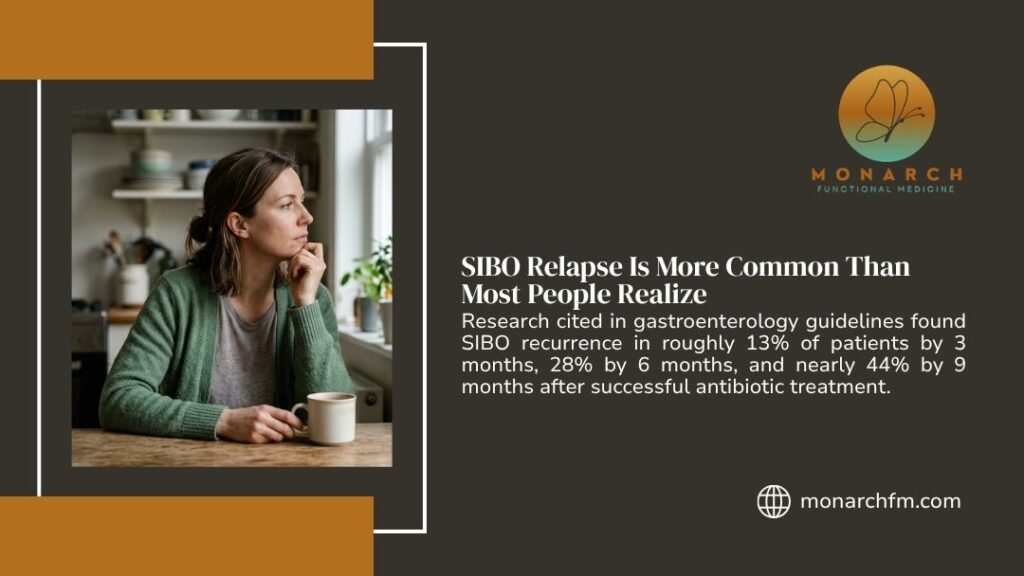
Often, yes, if the underlying cause isn’t addressed. Research cited in gastroenterology clinical guidelines found recurrence in roughly 13% of patients by 3 months, 28% by 6 months, and nearly 44% by 9 months after successful antibiotic treatment. This is exactly why recurrence prevention, motility, meal spacing, stress, and thyroid function are treated as part of the plan, not an afterthought.
Are herbal antimicrobials as effective as antibiotics for SIBO?
In at least one notable clinical study, herbal antimicrobial therapy produced SIBO remission rates comparable to the antibiotic rifaximin, with fewer reported side effects. That’s a meaningful data point, not a blanket recommendation; herbal formulas still carry interactions and contraindications that should be reviewed with a provider rather than self-selected.
Should I try berberine or oregano oil for SIBO on my own?
It’s worth caution. These can be effective tools in the right context, but dosing, duration, and safety depend on your specific gas pattern, medications, and health history. Berberine can affect blood sugar and drug metabolism; oregano oil can irritate the gut if overused. A clinician-guided plan reduces the trial-and-error that often makes symptoms worse before they get better.
Where can I find a SIBO functional medicine provider in Michigan?
Monarch Functional Medicine, based in Marquette, works with patients across the Upper Peninsula and the rest of Michigan on root-cause SIBO and broader gut-health care. A free 15-minute strategy session is the easiest way to find out whether the practice’s approach fits your situation.
When should I see a functional medicine provider for SIBO?
It is wise to seek help if symptoms keep returning, food tolerance is shrinking, constipation or diarrhea is frequent, weight loss occurs, nutrient deficiencies are present, or self-directed protocols have not worked. Michigan patients who want a personalized root-cause plan can speak with Monarch Functional Medicine to see whether their care model is a good fit.
A Clearer Path for Your Gut
SIBO treatment should not leave you more confused than when you started. A good plan should explain what may be happening, why symptoms may keep returning, and what steps make sense for your body.
The functional medicine approach to SIBO treatment is not about chasing every supplement or fearing every carbohydrate. It is about building a plan with order. Test when needed. Match treatment to the pattern. Support digestion. Repair the gut. Improve motility. Reintroduce foods carefully. Look at the whole person, not just the bloating.
For some people, treatment may include antibiotics. For others, herbal antimicrobials, digestive enzymes, berberine, oregano oil, diet changes, or motility support may play a role. The best plan depends on the person, the pattern, and the root cause.
If you live in Michigan and feel stuck with bloating, fatigue, brain fog, hormone changes, thyroid concerns, or stubborn digestive symptoms, Monarch Functional Medicine can help you take the next step with more clarity. Start with the Monarch blog for more root-cause health education, or schedule a conversation to see whether a personalized care plan is right for you.