
The Short Answer: What an MTHFR Mutation Means
“MTHFR mutation” often refers to one of two common gene variants, C677T or A1298C. These variants can affect MTHFR enzyme activity, but most people with them have no related symptoms. A positive result is not, by itself, a diagnosis or proof that the variant is causing a health problem.
You’ll often see the word “variant” used instead of “mutation,” and that’s the more accurate term. “Mutation” sounds like something broke. “Variant” simply means your copy of the gene is spelled a little differently than the most common version. Many healthy people carry these changes and never know it.
Maybe you landed here after a lab report flagged “MTHFR positive.” Maybe you have questions after months of fatigue, brain fog, poor sleep, or hormone changes. Those symptoms deserve attention, but an MTHFR result alone cannot explain them. This guide explains what the result can, and cannot, tell you.
What the MTHFR Gene Actually Does
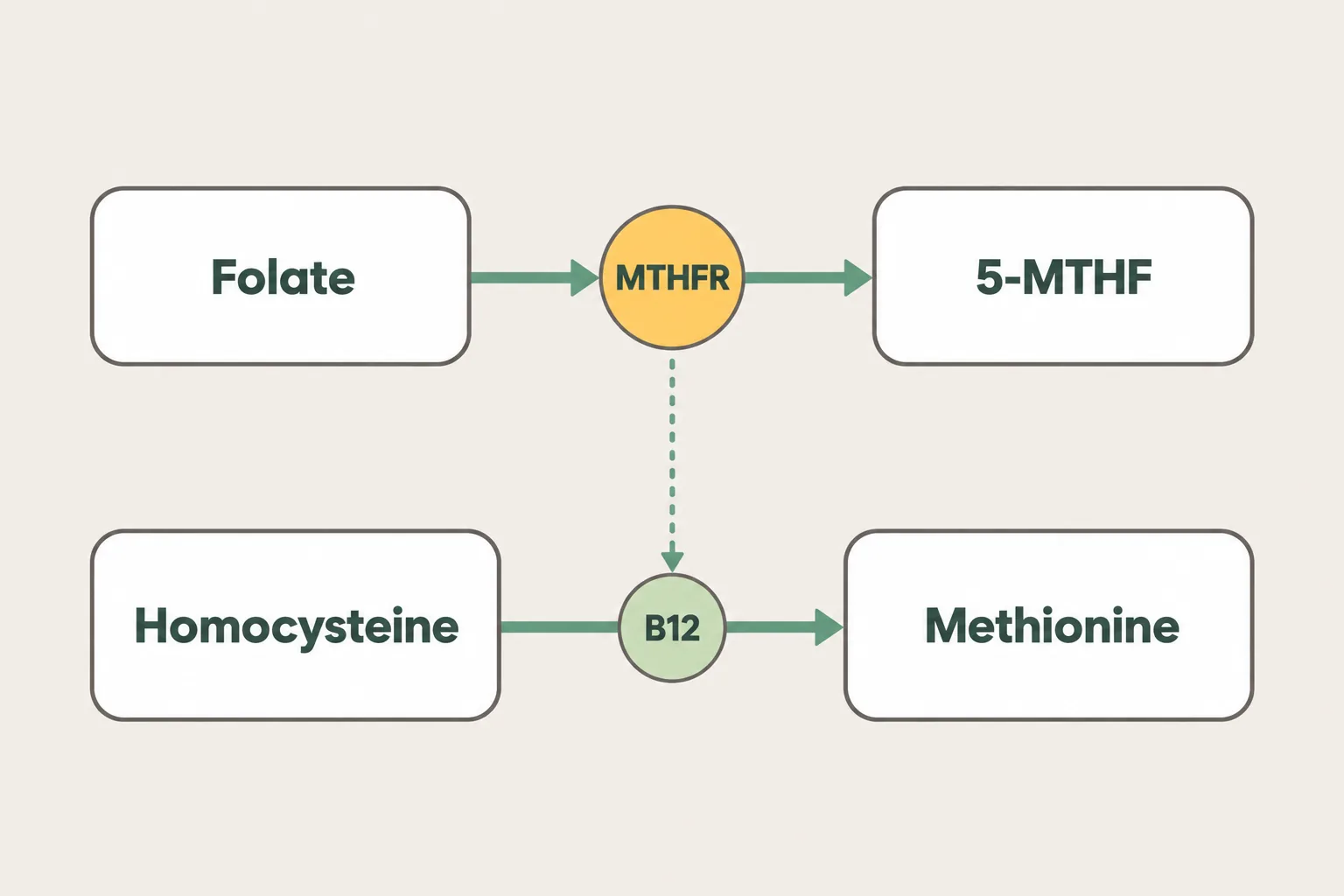
Genes are instruction manuals. The MTHFR gene holds the instructions for building an enzyme (a helper protein) with a long name: methylenetetrahydrofolate reductase. That’s where the letters MTHFR come from.
The enzyme helps convert 5,10-methylenetetrahydrofolate into 5-methyltetrahydrofolate (5-MTHF), one form of folate. With vitamin B12, 5-MTHF helps the body convert homocysteine into methionine. Common variants can reduce enzyme activity to different degrees, but a variant does not automatically mean folate or homocysteine levels are abnormal. See MedlinePlus Genetics’ MTHFR gene overview for more about the gene and its role.
This is one part of the body’s folate pathway. “Methylation” is a broad term for chemical reactions that transfer methyl groups; it is not an on/off switch, and a common MTHFR result does not show that all methylation processes are impaired.
Does Everyone Have the MTHFR Gene?
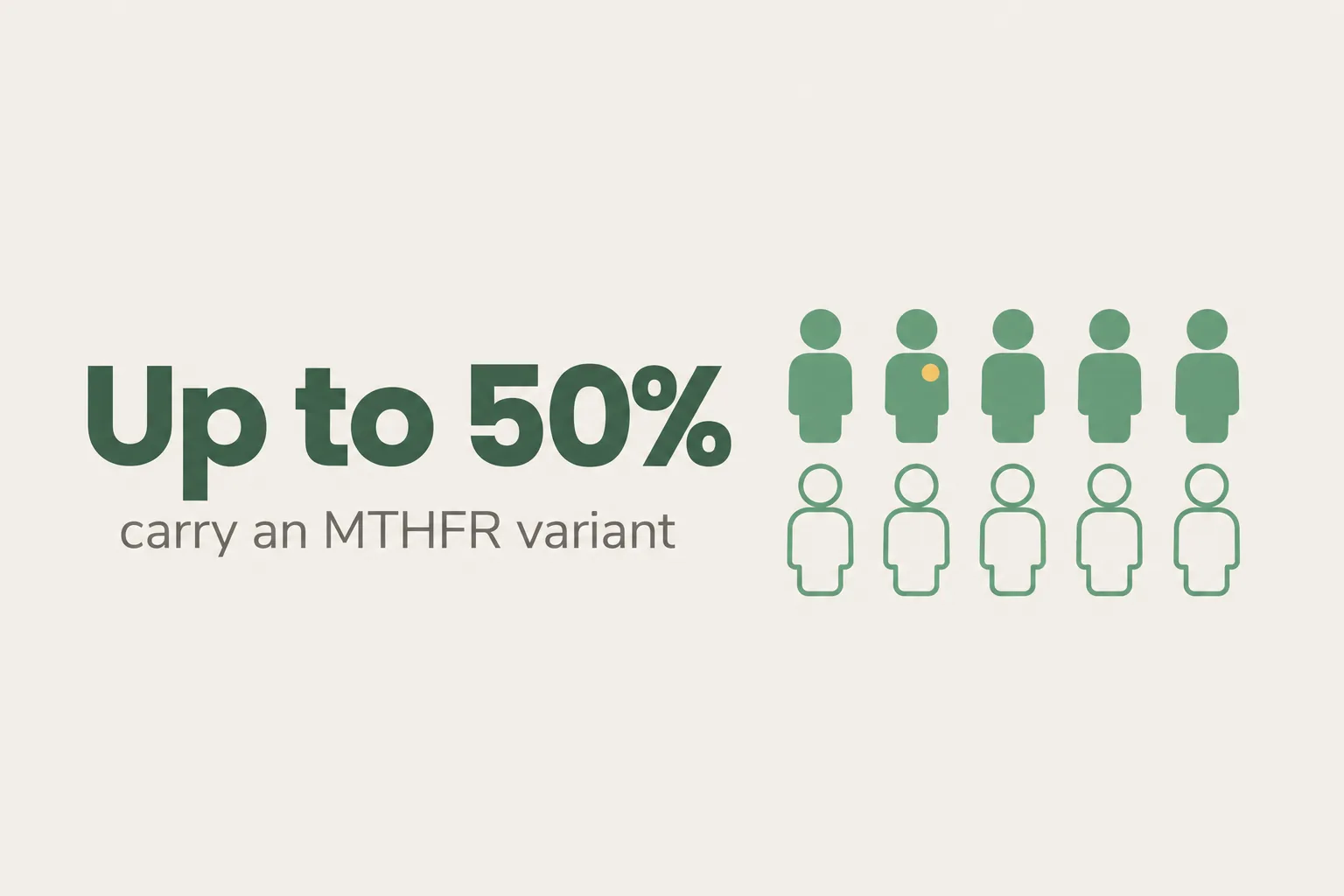
Yes. Everyone has the MTHFR gene. You actually have two copies: one from your mother and one from your father.
What differs from person to person is whether one or both copies carry a common change, and these changes are widespread. According to Cleveland Clinic’s overview of MTHFR gene variants, experts estimate that up to 50% of people have changes to at least one MTHFR gene.
That number matters. If something shows up in up to half the population, it can’t be the hidden cause of every unexplained symptom. A “positive” result is common, and on its own it isn’t alarming.
C677T and A1298C: The Two Variants You’ll See on a Report
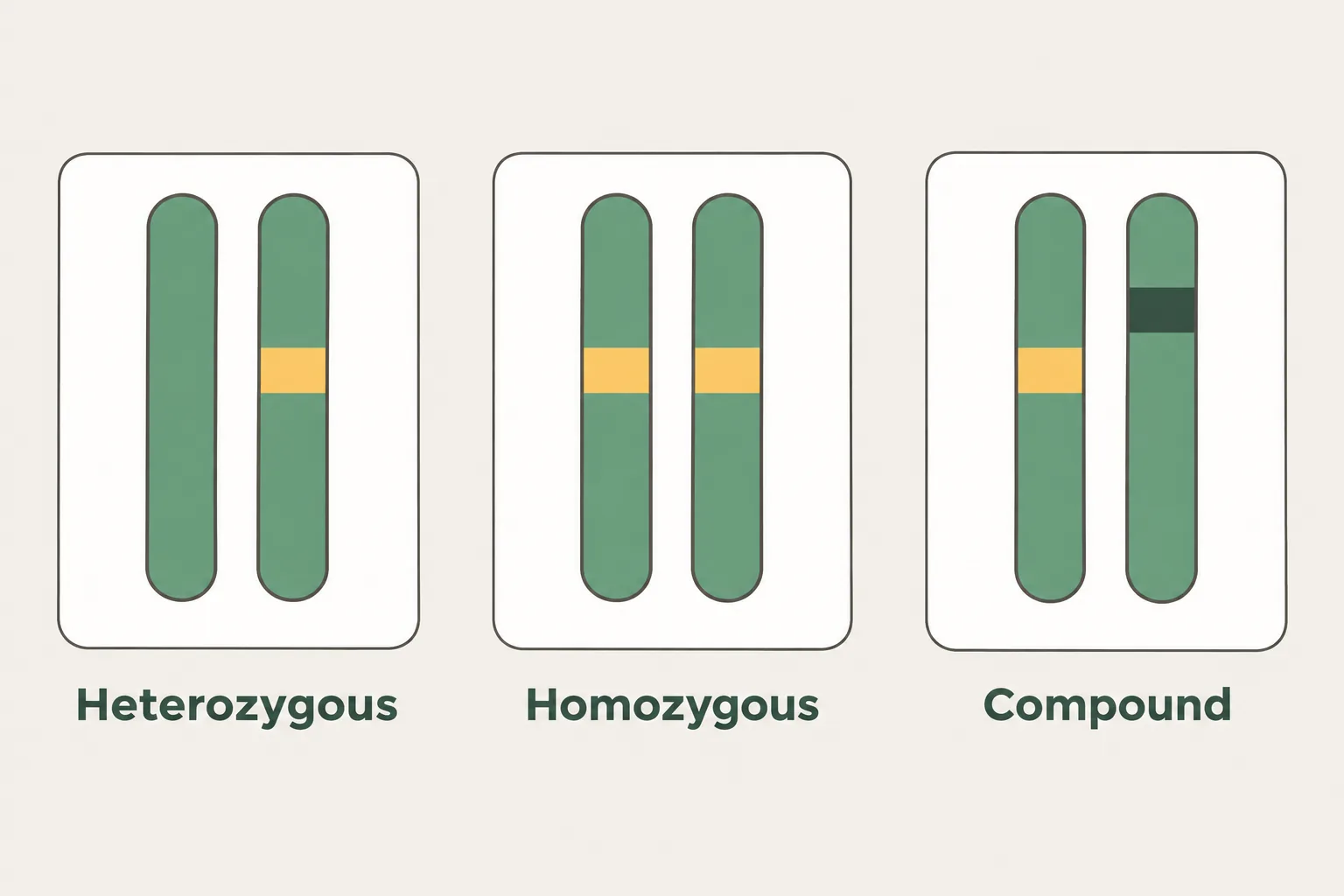
Most MTHFR tests look for two specific changes, called C677T and A1298C. The numbers and letters look intimidating, but they’re just an address. They mark the spot on the gene where a single letter of the code is different.
Your report will also tell you how many copies carry the change:
| Term | What it means |
|---|---|
| Heterozygous | One copy has the variant and one doesn’t. |
| Homozygous | Both copies have the same variant. |
| Compound heterozygous | You have one C677T copy and one A1298C copy. |
Of these combinations, two copies of C677T is the one studied most for its effect on enzyme activity and homocysteine levels.
C677T
C677T has been studied more extensively. Two copies can reduce enzyme activity more than one copy; the effect on homocysteine also depends on factors such as folate status. One copy may have a smaller effect. Neither result alone establishes a disease or predicts how a person feels.
A1298C
A1298C generally has a smaller effect on enzyme activity when present by itself. A result may be useful background for a clinician, but it does not diagnose a health problem.
What “MTHFR Positive” Means on Your Lab Report
When a report says “positive,” it means a variant was found. It does not mean a disease was found.
A typical result might read: “C677T: heterozygous. A1298C: not detected.” In plain language, one copy has the C677T variant, and the test did not find the A1298C variant.
A gene test describes an inherited variant; it does not measure your current folate, vitamin B12, or homocysteine levels. If there is a clinical reason to check those, each result needs to be interpreted on its own and alongside your health history. A high homocysteine result is not proof that a common MTHFR variant caused it.
A positive result can be confusing when one source says it is irrelevant and another says it explains many symptoms. Current clinical guidance does not support using common MTHFR variants alone to diagnose the cause of symptoms or to choose treatment.
What Happens When You Have an MTHFR Mutation?
For most people, nothing noticeable happens. They go through life without symptoms or problems tied to the variant.
For some, particularly people with two copies of C677T who also run low on folate or B12, homocysteine may climb higher than ideal. That’s the part clinicians pay attention to, because homocysteine can be measured, tracked, and worked on. The gene is fixed. Your homocysteine level is not.
Don’t confuse the common variants with a rare, serious inherited condition called severe MTHFR deficiency. That condition can cause very high homocysteine (a disorder known as homocystinuria) and typically shows up early in life. It’s a different situation from the everyday C677T and A1298C variants most adults find on a test, and it’s managed by specialists.
MTHFR Gene Mutation Symptoms: What the Variant Does and Doesn’t Cause
There is no proven, specific list of symptoms caused by common MTHFR variants.
You may have seen long lists online linking MTHFR to almost everything: fatigue, anxiety, headaches, weight gain, gut problems. Those symptoms are real but nonspecific. Their presence does not show that an MTHFR variant caused them.
Fatigue and brain fog are real, and they deserve answers. But they have many possible root causes, including:
- Thyroid function that’s off, even when labs are called “normal”
- Low iron or low B12
- Poor sleep or high stress
- Blood sugar swings and insulin resistance
- Hormone changes in perimenopause, menopause, or low testosterone
- Gut health problems that affect how well you absorb nutrients
A gene result should not end the search for an explanation.
At Monarch, an MTHFR result is considered in context, rather than treated as an explanation by itself. If symptoms are present, a clinician can decide whether any evaluation is appropriate based on the person’s history and symptoms. Homocysteine, folate, and B12 results may help answer specific clinical questions, but they do not establish that a common variant caused the symptoms.
MTHFR Variants, Pregnancy, and Women’s Health
Common MTHFR variants don’t cause a distinct set of “female signs.” Women most often run into MTHFR in a few specific situations: planning a pregnancy, after a history of pregnancy loss, or during a workup for fatigue and mood changes in their 40s and 50s.
That last situation is where things get tangled. Hormone shifts during perimenopause, including low progesterone, can cause poor sleep, irritability, anxiety, and fatigue. Those symptoms overlap with what people often blame on MTHFR. MTHFR doesn’t cause low progesterone, but the two can show up in the same person at the same time, which is why it helps to evaluate them together. If mood changes are part of your story, our page on hormone and neurochemical evaluation for mood swings explains how we look at hormones, thyroid, and genetics side by side.
MTHFR Variants and Babies
Common MTHFR variants generally do not cause signs in infants. Rare MTHFR deficiency is a separate condition. If you have concerns about a baby’s health or development, contact the child’s pediatrician rather than trying to interpret a common-variant result on your own.
MTHFR, Mood, and Mental Health: What Research Shows
Researchers have studied possible associations between common MTHFR variants and some mental-health conditions, but findings do not show that these variants cause a mental-health condition or determine an individual’s treatment.
Mood and brain health can be affected by many factors, including sleep, stress, medical conditions, medications, and life circumstances. If mood symptoms persist or affect daily life, speak with a qualified healthcare professional. Do not stop or change psychiatric medication because of an MTHFR result; discuss treatment decisions with the prescribing clinician.
Folate, Folic Acid, and Methylfolate: Clearing Up the Confusion
These three terms get mixed up constantly. The simple version:
| Term | What it is |
|---|---|
| Folate | Vitamin B9 found naturally in foods. |
| Folic acid | A form of vitamin B9 used in supplements and fortified foods. |
| 5-MTHF (methylfolate) | A form of folate produced through a pathway that includes the MTHFR enzyme. |
A common concern is that people with MTHFR variants cannot use folic acid. The CDC says people with MTHFR variants can process folic acid, and 400 micrograms (mcg) of folic acid each day can help prevent neural tube defects. The recommendation applies to people who could become pregnant, regardless of MTHFR status. Anyone with a history or condition that may call for a different dose should ask their clinician.
Some clinicians may recommend a particular form or dose of folate for an individual reason. That decision should be based on the person’s clinical situation, not on a common MTHFR result alone. Do not start high-dose supplements without professional guidance.
What Foods Should People with MTHFR Avoid?
This is a popular search, but a common MTHFR variant does not mean you need to avoid particular foods. A balanced diet can include folate-rich foods such as:
- Leafy greens like spinach, romaine, and kale
- Beans, lentils, and chickpeas
- Asparagus and broccoli
- Avocado
- Brussels sprouts
There is no general reason for people with common MTHFR variants to avoid fortified foods containing folic acid. Avoiding food groups based only on a gene result can make eating harder without addressing a proven problem. Ask a clinician or registered dietitian before making restrictive changes.
Is MTHFR Testing Recommended?
Routine testing for common MTHFR variants is not recommended in most cases because the result usually does not change care. The ACMG practice guideline on MTHFR testing explains why testing has limited clinical utility in common evaluations for thrombophilia. MedlinePlus also describes when a clinician may consider testing, such as in particular cases involving elevated homocysteine and relevant personal or family history; see its MTHFR gene test overview.
MTHFR testing is not a routine test to explain recurrent pregnancy loss or to assess blood-clot risk. A clinician can decide what evaluation is appropriate based on the individual history and current guidelines.
If you already have a result, ask what clinical decision it changes. Genetic testing can be useful in some settings, but the result needs to be interpreted in context. Monarch’s article on what genetic testing in functional medicine may reveal provides more background.
Why Clinicians Often Don’t Order MTHFR Testing
If a clinician says a common MTHFR result is unlikely to explain your symptoms, that does not mean the symptoms are unimportant. Current guidance generally discourages testing for common variants because the result alone usually does not change treatment. A useful next step is to ask what other causes fit your symptoms and what evaluation, if any, would guide care.
What Care May Involve After an MTHFR Result
There is no treatment that changes a person’s genes. Any care should address a specific health concern or abnormal finding, not the common variant by itself. Depending on symptoms and history, a clinician may consider relevant tests or other evaluations; this does not mean everyone with an MTHFR result needs testing for hormones, thyroid function, iron, blood sugar, or gut health.
If a nutrient deficiency or another condition is identified, care should target that finding. Supplement choices and doses should be individualized, and a common MTHFR result alone is not a reason to take high-dose folate, B vitamins, or other supplements. Results vary, and no specific outcome can be promised.
Frequently Asked Questions
Related readingGenetic Testing | Functional Medicine | Monarch FMRead the guide →Frequently asked questions
What does MTHFR mean?
Is an MTHFR mutation serious?
Can MTHFR cause fatigue or brain fog?
Should I take folic acid if I have an MTHFR variant?
Does MTHFR testing explain pregnancy loss or blood clots?
Can my MTHFR result change?
Moving from a Confusing Result to a Clear Plan
An MTHFR result describes a common genetic variant; it does not diagnose the cause of symptoms. If you are still dealing with fatigue, brain fog, mood changes, weight changes, or hormone and thyroid concerns, a clinician can help decide what deserves evaluation based on your symptoms and history.
The 12 Week Reset is Monarch’s starting point for patients in Michigan. It is a structured, personalized program intended to review health concerns and develop an appropriate plan. Learn more about the 12 Week Reset.